Sunday, 20 July 2014

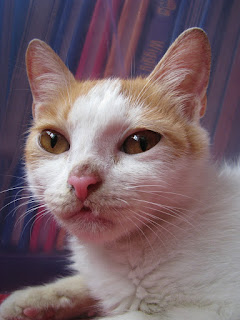
Goodbye Mickey

In the early hours of Friday morning, Mickey died.

In the short time that he was with us, he brought a joy into our family that was entirely disproportionate to his size.

For Miya, here was a cat who was finally hers.  Maggie is mine.  And Kitty is Mulan’s.  But Mickey was Miya’s.  He was just the right size for her to carry around.  And carry him around she did (sometimes upside down).  He was a frequent part of her games, too, and he often got carried around our home in boxes made lovingly into comfy beds.

For Kitty, he was her baby.  Especially in the first few months, when he was smaller, she would often snuggle up to him, licking him all over when he was unable to wash himself.  When he was feeling sick, she would sit with him, often squashed together in a too-small box.

For Mama, he was a window into the cat world.  He helped show her that cats aren’t all identical, slightly threatening, evil-looking animals.  With Mickey, Mama began to see that every cat has his or her own unique personality.  And Mama warmed up in a big way to Mickey’s sweet, cute, gentle, bumbling and helpless ways.  Through Mickey, Mama also warmed up to Kitty, when she saw how mothering Kitty was.

For Maggie, Mickey was still an intrusion into her life.  She didn’t appreciate it when he flopped awkwardly on top of her, and she bit him gently or walked away.  But I like to think that he helped her to be a little bit more mellow and accepting of other animals in her home.

For Mulan, he was a very cute kitten to love, play with and learn to take care of.  He was the realisation of so many of her storybooks, where the young girl finds and takes care of the helpless kitten.  He was also a big part of her games, and she carried him around a lot, too.

And for me he was Mickey, another member of our family to love and take care of.  Countless hours were spent with him curled sleeping on my knee.

He came into our life when, with a meow, he said, “hello, please help me.”  We nursed him through his broken leg, but he was always a little weaker, clumsier and wobblier than he should have been.  We will never know exactly what his illness was [blog entry lost], but in the end it was this that killed him.  Right from his earliest moment, his life was destined to be measured in weeks and months, not years.  He was a fighter, and several times he pushed himself through his bad times to again play and laze in the sun.  But eventually he was too tired and weak to keep holding on.

Mickey’s funeral was yesterday (Saturday) evening.  He stayed with us overnight on Friday, and Mama set up a lamp next to him to shine throughout the night.  Yesterday afternoon we all helped decorate his cardboard box coffin.  Mama put in his special things—his vet card and his medicine—and covered him with a cloth blanket.  Then, together we went for a walk and found a quiet spot at the foot of a big tree in a nearby bush.  We all got very hot and sweaty jointly digging the hole (and we all got dozens of mozzie bites!) but in the end the hole was big enough, and we placed Mickey’s coffin inside, before covering him over.

Thank-you Mickey, for saying meow to us and choosing our family.  We miss you.

Sunday, 13 July 2014

A funeral at the ancestral home

Last weekend a distant family member died, so this week the extended family congregated at the old ancestral village home for a traditional funeral.

We went there too, leaving our home early Friday morning and returning late last night (Saturday).

The ancestral home is in a village about an hour by car from the city of Meizhou (population over five million), which is about six hours by train from Guangzhou.  Our trip there was fairly relaxing, apart from two incidents.

Firstly, we got caught in the morning rush-hour traffic getting to the train station.  With sweat dripping down our faces from running hard, we jumped onto our train just a couple of minutes before it left.

Secondly, our taxi driver from Meizhou to the village thought he was a Jedi and calmly drove on the wrong side of the road while passing cars at high speed on blind corners.  The girls and I rattled around in the back seat with no seatbelts.

Miraculously, we survived the journey there and back.

This was the fourth time I had visited the village, though the last time was back in 2008 when Mulan was still not walking.  I enjoy it there, and if I could choose between the village and our apartment home in Guangzhou, I would definitely vote for village life.  (Though if I lived there I would turn one of the fish ponds into a swimming pool, create more of an outdoor dining area to take advantage of the beautiful mountain views, and possibly have a bit of a grassy lawn rather than the Chinese-style all-concrete front section.)

Mama’s father’s mother’s father build the big old dwelling in about 1930, after returning to China from working overseas.  Apparently, he had grand plans for his many children to raise their families there together, and so he built a couple of huge and beautiful buildings.  Sadly, though, most of his children moved away, and the old buildings were mostly left bare and empty.

During the Chinese Cultural Revolution, the big mansion was attacked and many of the most beautiful artistic parts were destroyed.  Time, too, has taken its toll, and the big wooden beams holding up the roof have slowly become unsafe.  One of Mama’s uncles is currently keen on restoring this biggest building and has been the driving force behind recent repair-work (funded mostly by rich overseas rellies).

Uncle has grand dreams of turning the mansion into a hotel, and he is currently modernising one section by fitting out five two-room apartments.  His hope is that the middle-classes from the nearby city will want to use it as a village retreat for a month or two at a time.  It is a wonderful, romantic, idea, though from a business perspective it is doubtful.  While to us this big building is a special beauty, in the area they are a dime a dozen and most families are just abandoning them when they move to the cities.  Nonetheless, we all hope it works out for Uncle.  (If anyone wants a romantic, old-Chinese-village-style holiday, just let me know!)

Two sets of descendants have continued to live in the other building over the years.  This is where Sanmei Ayi and her three sisters (Mama’s second cousins) grew up as children, and their parents still live there.  When we stay there, we always stay in their section of the home, and it is always very comfortable and welcoming.

When we arrived at the village in mid-afternoon, the funeral ceremonies had already started.  I don’t even pretend to understand much of what was going on, but the essential image is that of a lot of people and a lot of noise.  Along with the extended family, it appears that a lot of the village was there too.  Mama tells me that it is important that there is a lot of noise happening (traditionally, to scare away the bad ghosts) so the family provides heaps of free food and entertainment for a couple of days to attract the locals.  These locals sit there on the aforementioned concrete front section eating and playing mah-jong (and acting as ghost-deterrents).

Miya might be part-ghost because the noise certainly really scared her, too.  She clung tightly to me and put her hands over her ears at the loudest parts.  Often she and I walked away and either watched from a distance or did other things elsewhere.  Mulan also put her hands over her ears a lot, but she was old enough to be okay with it, and she stayed with Mama throughout most of the activities.

The loudest things came from three sources.  Firstly, as we all know, Chinese love long strings of bangy firecrackers.  Secondly, as we all know, Chinese are like teenagers when it comes to their loud sound systems (just visit any promotional performance at a shopping centre).  Just outside the main mansion doors, they positioned desk-height speakers to blast out their music and microphoned voices.

But thirdly, and surprisingly, they had hired a Western-style uniformed marching band, with drums and brass instruments led by a conductor with an arm-length baton (which was swung around but not thrown into the air, as far as I saw).  (Their uniforms, however, all looked very tired and stained, and their brass instruments were brown and unpolished.)  Mama tells me that this is a recent modernisation to traditional Chinese funerals.  Given the volume the marching band was producing as they did their thing back and forth across the front doorway, I can understand why Chinese would have latched on to this idea.

Dropping our bags when we first arrived, the four of us immediately paid our respects to the old granny by bowing to her picture while holding three incense sticks each.

Besides noise, one of the other central themes of the funeral ceremony is the (mostly symbolic now) way that the younger generation must provide for the material needs of the deceased.  Granny’s picture had been placed inside a very elaborate and very blingy-looking two-dimensional cardboard mansion.  Someone had cut out pictures from Home-and-Garden-style glossy magazines and pasted these in each of the mansion windows.  This is to (symbolically) give Granny a beautiful mansion to live in in the afterlife.  It was intriguing, though, that most of these pictures were of living and dining areas (she must have had half a dozen or more living areas, all with very different styling).  There were no bedrooms, toilets or laundries.  Only one picture had a kitchen, which was obscured and in the distance.  One picture was of an outdoor dining area, but this was confusingly on the second floor (maybe Granny has a sloping section in the afterlife?).  Forever the flippant little pedant, I whispered in Mama’s ear about this.  Word came back that those other essential rooms were all at the back of Granny’s new mansion, and so couldn’t be seen from these front windows.  That is a relief for Granny.  I understand that this cardboard mansion was burned for Granny, as it is only via the smoke from burning that the deceased can collect these afterlife gifts.  (I understand that while some Chinese still believe in this literally, for most it is merely a symbolic ritual and reminder of loved ones.)

Later that night, the girls and I crashed into bed one by one, with the activities still in noisy full swing.  The three of us slept together in a big traditional (but new) bed, which has three of its four sides closed.  Mulan was farthest in, then Miya, then me.  Theoretically, these beds are a wonderful idea, and I love their look, but they are not very practical to sleep in.  For one thing, it means that people inside have to climb over those on the outside to get out.  For another, it means that slightly taller people like me bump their feet on the board at the foot of the bed (I prefer to hang my feet slightly off the end of the bed).

Mama stayed up later with the others and slept in Sanmei Ayi’s room.  She informs me that tradition dictates that at least some of the family members need to be awake all night.  Mama tells us that we missed some good entertainment programming, including professional fire dancers.  I think I heard the music stop around ten o’clock, but I understand that they still kept up quiet prayer activities throughout the night.

When I woke around five-ish it was still dark, and it was just getting light when the girls both woke about half an hour later.  We wandered on out hoping to see the sunrise, but we were slightly too late.  Everyone else was up and moving again soon, too.

Hobbit-style, breakfast in the home was followed by a second group breakfast for the funeral.  Mulan struggled to eat anything for second breakfast, but Miya happily ate hers.

Between breakfasts, there were more planned activities.  The loud noises drove Miya and me away, and we watched on from a distance.  A professional singer cried while she sang, to get everyone in the mood.

Next, the Buddhist monks and the marching band led the procession out behind the mansion and up the hill.  The hillside is dotted with gravestones and pagodas of various oldies (positioned with solid feng shui views of the village below), and we walked up several minutes to where Granny is to be buried.  The ceremony complete, we came back down again for the final funeral activity of second breakfast.

The other main activity we did before lunch and before returning to Guangzhou was to pay our respects to Mama’s ancestors.

The first time I went to the ancestral village was for Mama’s grandma’s funeral in 2006.  Grandma has a very lovely pagoda built for her on the hillside.  Her husband and their son, Mama’s father, who both died much earlier, are also there.

A very meaningful activity for us each time we visit the village is to go up to the pagoda and ritually offer food and burn ghost-money.  Mama personally doesn’t believe the rituals literally, but as I see it this doesn’t lessen the meaning of the rituals one little bit.  Done in the right frame of mind, I think it is a lovely way to remember the oldies.  Doing something active keeps the hands busy while letting the mind silently reflect on the loved one.  And when this activity is familiar and homely, like preparing food, it all brings back the memories even better.

First of all, after wiping clean the gravestones, food and drink is laid out in front of their pictures.  Then with incense we bow to them.  Several minutes later, when the incense is halfway burnt, we burn the ghost-money.  This is similar to burning the granny’s mansion, in that burning (fake) paper valuables symbolically gives Grandma her goods that she can then enjoy in the afterlife.  Jointly, we burnt several millions of British pounds and Hong Kong dollars, as well as other indeterminate currencies and bars of gold.  When the wind swirled around Mama told me that this means that the goodies are being received.

Back down the hill, we had lunch before our Jedi-master taxi driver took us back to Meizhou.  This time we were about 45 minutes too early for our train.  Sanmei Ayi caught the train with us, and we had a very relaxing and pleasant journey home.

(PS, there are no photos of the events as I didn’t take my camera with me; I didn’t think it was appropriate for a funeral.  However, clearly, Chinese don’t think like me and they had a professional cameraperson snapping pictures and taking videos of all the events.)

Sunday, 15 June 2014

Book review: Heidi

I was very surprised to discover just how pushy Heidi is in its Christian evangelism.

You might recall that I mentioned last month [blog entry lost] that I had started reading the book to Mulan.  Well, we finished it on Friday night.  I had never read the book, and I don’t recall ever seeing any of the many movie adaptations.  But I decided to introduce it to Mulan as I had the impression that it is about a young girl whose bright personality brings happiness to everyone she meets.  And it is set in Switzerland.  And it is a famous children’s classic.  So, it seemed good to try.

It was all that.  It really is a lovely story, and Mulan thoroughly enjoyed it.  There are no scary bits, and, for us big-city-dwellers, the green grass, blue sky, fresh mountain air and friendly goats were exotic and enticing.

Unlike The Railway Children, which was our previous book, Mulan had no trouble at all with understanding everything that was going on.  Heidi is a much simpler story, and very easy to follow.  The characters are not too deep, and their actions are straightforward.  The slightly more unpleasant characters, Miss Rottenmeier and Deta, are consistently and obviously the big grumps, in a two-dimensional kind of way.  But they are still not too bad.  Similarly, all the other adults are two-dimensionally kind-hearted and lovable.  The sad ones, Grandfather and the Doctor, are, in an uncomplicated way, immediately and permanently cheered up by the combination of Heidi and the beautiful Swiss Alps.

It also had greater meaning for us because of our holiday in Switzerland and Germany last year.  Even though we never got as far as the Alps during our trip, our time around Lake Constance, with the mountains, lake and towns, gave us some small sense of what Heidi’s home must have been like.  Reading the descriptions of the places allowed us to recall our own experiences and compare them with Heidi’s life.

For all of these reasons, Heidi is a delightful young children’s book.

However, chapter 10 came as a big shock to me.  It was at this point that the story changed from being about Heidi, to being a thinly disguised attempt at pushing Christianity.  Up until this point, most of the storyline had been gentle descriptions of events and simple, short conversations.  Suddenly, in this chapter, the newly arrived Grandmama launched into a (comparatively) much longer sermon about how Heidi should pray to God, and that God will solve all her problems.

I want to make it clear here that I have nothing against books in which the characters are Christian, and express Christian points of view.  But what I found questionable was the sudden and dramatic change of tone in the book.  It was a style that didn’t sit right when compared with the earlier chapters.  There didn’t feel like there was any textual reason for this sudden and dramatic change from neutral description to overt, lengthy preachiness.  It was textually strange for Grandmama to say all of that.

Up until that point, no one had given long opinionated speeches (any God-talk was done in passing, and completely contextually appropriate).  After that point, there were several more opinionated speeches, all of which were aimed at convincing the other characters (or, more likely, the reader) of the Christian point of view.  No one gave longer speeches on any other topic, and God was a central theme of many of the characters’ interactions after that point.  From the perspective of a reader only interested in the sweet story of a delightful little girl, this lecturing was irrelevant and ruined the enjoyment.

I also felt a little tricked by the author.  This change in tone came almost halfway into the story.  Those of us who didn’t like this change of tone could hardly stop reading the book at that point (in my case, Mulan would have demanded that I continue, had I said anything).

So, if someone were to ask me to summarise the theme of Heidi, I would say that it is not about a sweet young girl’s life in the Swiss Alps.  Instead, I would say that it is primarily a religious text, aimed at convincing children of the need to trust that God knows best, even when things appear not to be going so well.

For those of us who believe that God doesn’t exist, and would prefer to raise our children in a secular way, we thus need to question the appropriateness of using Heidi as an early reading book.  Had I pre-read the entirety of the book first (and not just skimmed the first few chapters), I probably would not have given it to Mulan so soon.  I would have preferred that she had had a bit more critical awareness and life experience first.

You may be wondering if, despite this, Heidi could still be used as a P4C book.  I think possibly but not ideally.  A good P4C book is one in which the text itself gives no clear-cut answers.  It is supposed to open up ideas and conversations, not give one-sided opinions.  For this reason, The Railway Children could be a good P4C book.  But Heidi is too one-sided, so it is not so good.

Therefore, despite the nice story, and its supposed classic status, I would not include Heidi on a young child’s recommended book reading list.

Saturday, 31 May 2014

Book review: Ender’s Game (or being a teenager again)

Twenty-five years ago, when I was 13 years old, I competed in an athletics competition in Dunedin (in the South Island of New Zealand).

Those of us in the Auckland team flew down to Dunedin, and, before competing, we did a bus sightseeing tour to Queenstown and back again.  If you have been to Queenstown you will probably know how stunningly beautiful the scenery is in that area.

The trouble is, I mostly don’t know how stunningly beautiful the scenery is.  For the entire bus journey, I had my nose stuck in a book.  Whenever I looked up to see where we were, I thought, “ho hum, we haven’t yet arrived at our hotel.  I wonder why it is taking so long to get there.”  I don’t think I realised that I was supposed to be enjoying the scenery.

The book I was reading on the bus was from Frank Herbert’s Dune series (Heretics of Dune maybe, or Chapterhouse?)  Needless to say, I thoroughly recommend the series.  It is far more enjoyable to a teenage boy than stunningly beautiful scenery.

Last week, I was a teenage boy again.

When I was at the bookshop buying Mulan and Miya’s schoolbooks, I also bought Orson Scott Card’s Ender’s Game.  After the children went to sleep last Friday, I read it until 3:30 in the morning.  I had four hours sleep, and then when I woke I finished the book that morning.  (Luckily, it was Saturday, so Mama was around to take care of the girls.)

It should go without saying that Ender’s Game is a brilliant, can’t-put-down story.  It is perfectly paced and tensely exciting.  The twist at the end is shocking (though I must admit I did slightly suspect it coming).  It is the sort of book that I would have devoured as a 13-year-old, along with the rest of the books in the series, and I am slightly surprised that this is one book series that never caught my attention back then.

The book has the standard teenage-boy plotline, with heroes acting heroically.  It has none of that wishy-washy incompetent-loser-struggle story so beloved of school English teachers.  It is about super-smart people doing inspirational super-smart things.  Exactly what a teenage boy needs, in my opinion.

The author, Card, tells us that the book was inspired by Isaac Asimov’s Foundation series (another brilliant book series, in my opinion, which I read as a teenager).

It also has similarities with Herbert’s Dune (though in my opinion Ender is far less deep).  The storyline of both books centre on the maturing of a child genius who has the potential to save the world (Ender Wiggin in Ender’s Game; Paul Atreides in Dune).  Again, this is perfect teenage boy stuff, where the super-smart people are young themselves.

As an adult though, I am allowed to be slightly more cynical.  As much as I loved being entertained by the storyline of Ender’s Game, I felt that I couldn’t quite suspend disbelief.

In his introduction to the new edition, Card discusses a letter from a school guidance counsellor for gifted children, who thought the depiction of gifted children in the story was unrealistic.  She said that real children don’t speak and act like the children in Ender’s Game.  Card strongly disagreed.

I have to say that I agree with the school counsellor.  At the beginning of the book, when Ender is six years old, he is shipped off to military school.  For the next several years, he trains intensely, and before he reaches ten years old, he is devising new military tactics no one has tried before.  At something like twelve years old, his genius military brain is saving the world.

Inspiring stuff for teenage boys.

But probably not very realistic, even if Ender and his companions are supposed to be the several best and brightest children in the entire world.  Would even the best and brightest children talk and act in that way?  I doubt it.  And contrary to Card’s assertions, I highly doubt Card and his acquaintances thought and acted like that when they were that age.  Similarly, is it plausible that pre-teens could have better military minds than people with fifty years more experience?

Herbert’s Dune series could get away with four-year-old highly-trained assassins and so on, because it is set twenty-whatever thousand years in the future, and they are explained away by technological, chemical, and breeding advances.

But ten-year-old world-leading military geniuses in Ender’s near-future Earth world?  I couldn’t completely suspend disbelief, so I couldn’t completely accept the book.  I guess I have been thinking homeschooling and teaching for too long now.

Having said all that, I still think Ender’s Game is a great book—both entertaining and thought-provoking.  It is more of a teenage book than an adult book, and, with suitable discussions afterwards, it could be a nice introduction to military ethics (amongst other things).  I would definitely put it on the teenage schooling reading list.

Thursday, 29 May 2014

Mulan’s schoolwork

When I bought workbooks for Miya, I also got some more for Mulan.

For the last few months, Mulan has mostly been doing maths workbooks (and before that, it was science).  So it was time to get back to doing a bit more reading comprehension.  This is what I got:


Previous reading comprehension workbooks we’d done had suggested that Mulan was at, or just slightly ahead of, her age in English.  (This makes sense because she is simultaneously learning Chinese.)  Five months ago, she finally finished the Grade 1 advanced learner book that we had started almost two years ago.

So my guestimate in the bookshop was that the book on the left, which is for seven to eight year olds, would be a little easy but mostly about right.  I guessed the Grade 3 book on the right may be a little too challenging right now, but I expected it would be about right in a month or two, after finishing the first book.

It turns out I was wrong.

When I got home, I showed all the new books to a delighted Mulan and Miya.  They both immediately excitedly said that they wanted to do a page or two of each book every day.  They didn’t want to put any away for later.

I replied to Mulan that I had expected her to complete the easier book first and the other after.  But she wouldn’t hear of that.  So I said okay she is welcome to try the Grade 3 book, and see what she thinks.

It turns out that the Grade 3 book is more Mulan’s level.  For the past week, she has used the first book as an easy warm-up (doing it all completely independently and correctly herself), before turning to the second book for her real lesson.

Each day, with the second book I start Mulan off by getting her to read aloud the study words of the day (she can read them all herself with no trouble).  I then check she understands the tasks (she always does).  She then silently completes the exercises while I help Miya with her work.  At the end of each page, I check Mulan’s work (mostly all right, with a few minor corrections).

When Mulan has done two pages of each of these two books, she then continues with the maths book we bought last month.  She does a page or two of this, which I check at the end.  Our big thing at the moment in this book is getting familiar with times tables.  It is a good challenge for her to calculate them in her head, though after several of them her brain gets tired.

Finally, if she still has enough brain energy, she has a look at the activity pad:


We haven’t done much yet with the multiplication flash cards, except to suggest that Mulan could play some games with them when her friend Yiran comes to our place every day after school for babysitting/play/homework.  Mulan thought that would be a fun idea.

Oh, and at the beginning of each school lesson I read aloud to the girls a page from this How Come? science book, which was a present for Mulan last Christmas:

Miya’s schoolwork

Miya’s schooling situation is very different from Mulan’s at that age.

With Mulan, we started workbooks just before she turned four, and we worked on them for maybe about ten or so minutes a couple of times each week.  She didn’t finish her first workbook until she was four years and two months.

In contrast, Miya finished her first two workbooks on Monday.  She is three years and nine months.

The reason Miya is speeding through these workbooks so fast is that she likes to do school just as often as Mulan does.  This means that she does it every day, for maybe half an hour or so at a time.  (Mulan now does about an hour each day.)

All of this meant that last week I had to go back to the Guangzhou Book Centre bookshop to pick up more book supplies.  (I went on my own and had a wonderful relaxing time there!)  These are the books I got for Miya:


I also discovered that I had stored away in my future resources slash pressie cupboard this book, which I gave to her, too:


Each day this week Miya has been doing a couple of pages from each of these four books … and loving it.  Every morning, she nags at me to start their “school time”.

Is all this extra school time bookwork helping speed along Miya’s learning?

I doubt it.

For one thing, it is all swings and roundabouts.  Gains in one area are offset by losses in other areas.  Soon enough, things will more than likely even up.

For example, one other big difference between Mulan and Miya at that age was that I read to Mulan a lot.  When it was just Mulan and me together, we would often snuggle up together during the day with a reading book (or ten).  It was often an hour or two every day.  That just doesn’t happen with Miya.  In general, the only time I get to read to Miya each day is at night for about ten minutes just before bed.  So, Miya is far less advanced with story reading than Mulan was.  Which means that she is less familiar with letters and words.  She doesn’t yet know how to recite her ABCs (Mulan learnt from Dr Seuss).  And she gets bored quicker with longer stories.

Another big difference is that Miya has had a lot more free time playing with Mulan and other big kids.  This has resulted in her gaining skills and knowledge that would have been completely outside Mulan’s world at that age.  (I am a firm believer that children’s free play is not merely frivolous and fun; it is an essential part of how they learn [blog entry lost].)

And still another big difference is due to personality.  Miya has a much more spatial/sporty/engineering/physical mindset.  She loves screwdrivers and hammers, and likes to “fix” things.  She also likes sitting down and colouring in (which Mulan didn’t).  I suspect it is this background that has given her an advantage when holding her pencil, and has made her more advanced with her writing than Mulan was at that age.

I also doubt our workbook sessions are helping speed along her learning because I have read studies showing that starting children early with schooling does not make them more advanced than their slower-starting peers later on.  The education system in countries where children start school at seven is just as (or more) successful as those where children start at five (or younger).

So, I have no illusions that Miya’s more frequent workbook sessions will make her more advanced.

What we do suits Miya, and it suits our family lifestyle.  But I’m sure it is not better than what we did with Mulan.  (Or worse, for that matter!)

My next post (when I get around to it) will be on Mulan’s current schoolwork.

Saturday, 10 May 2014

Sightseeing in Guangzhou

“No changing of place at a hundred miles an hour will make us one whit stronger, happier, or wiser. There was always more in the world than men could see, walked they ever so slowly; they will see it no better for going fast. The really precious things are thought and sight, not pace. It does a bullet no good to go fast; and a man, if he be truly a man, no harm to go slow; for his glory is not at all in going, but in being.” (John Ruskin)
 Suppose you decided to go to China for a sightseeing holiday, where would you go?

I’m guessing places like Beijing, Xi’an, Tibet, Hong Kong, Macao, Guilin, and Shanghai might spring to mind.  So might many other places.  China is a big country.

Guangzhou probably wouldn’t be high on the spring-to-mind list.

When My Big Sis said that she and her family were coming to China for seven weeks, my first question was where else in China should we take them.  It seemed obvious that there would not be enough to see and do only in my adopted home city of Guangzhou.

So, I suggested two outside-Guangzhou trips.  Beijing was an obvious choice, for maybe a couple of weeks.  And Xingping, which is a lovely little place nearby Guilin, was suggested for a shorter countryside trip.

As it turns out, we never went to either of those places.  My Big Sis and her family spent their entire time here in Guangzhou (they returned to New Zealand a few days ago).  And we never ran out of things to do.  In fact, not only were we kept busy the whole time, we also never completed our Guangzhou to-do list.

What did we fill our time with?

We went to a few parks:

Baiyun Mountain is a big park area to the north of the city.  There are many whole-day semi-nature walks up and around the mountain (I say “semi-nature” because it is all very civilised with paved paths and plenty of shops).  The cable car ride up from the south entrance (metro line 5, Taojin, then bus 245) is definitely worth it for its stunning views.  At the top of the cable car, we walked north to Moxing Summit, which is the highest peak in the area.  Continuing north down the worryingly-steep steps on the other side of the summit left us with rubbery legs, but we all managed to keep going.  We followed the path past the reservoir (which we didn’t swim at, but I read that it is possible) and out the west gate (where bus 424 took us to metro line 2).  All this took us about 10 hours.

Xiaogang Park (metro line 8, Xiaogang) is a medium-sized park just one metro stop, or a short walk, from our home.  It is a pleasant little half-day outing, and the children loved the several cheap amusement park rides near the entrance.

Dongshanhu Park (metro line 6, Donghu) is another medium-sized park fairly near our home (easier for us to get bus 211 rather than the metro).  The boats for hire on the lake are enjoyable.

Yuexiu Park (metro line 2) and Martyrs’ Park (metro line 1) were on our to-do list, but we never got to them.  Yuexiu Park is where the goat statue, the symbol of Guangzhou, is located.

We went to a few shopping areas:

Shangxiajiu Pedestrian Street (metro line 6, Huangsha) and Beijing Lu (metro line 1/2, Gongyuanqian) are horribly crowded street malls, but they are also cultural must-sees.  Beijing Lu has an interesting historical section, where you can see the ancient paved city streets.

At IKEA (metro line 1/3, Guangzhou East Railway), it is interesting to see the locals make themselves at home in the air-con coolness and comfort of the displays.  Us home-types also like to buy lots of stuff there.

It is an interesting walk through the richer parts of town from IKEA to Guangzhou Book Centre (metro line 1/3, Tiyu Xilu).  The book centre has several floors of books and the English book section is good and cheap.

Decathlon sports mega-store (metro line 3, Xiajiao) is worth a visit, both as a source of cheap-but-good sports equipment and as a playground for the children.  But it is best to go during school hours, if the children want to play with the free equipment.

And there are countless other shopping malls dotted throughout the city.

Several other city spots are worth a visit:

Shamian Island (metro line 6, Wenhua Park) is a must-see if you are interested in pretty European buildings from a hundred or so years ago.  The island was a sandbank before the Europeans built there, and so if you are lucky enough to go during the rainy-time, you can walk the streets with the water up to your thighs.  The US embassy is on the island, as are lots of souvenir shops.

Ersha Island (metro line 6, Donghu).  This island has two things going for it.  Firstly, it is a cultural centre, with an art museum, pleasant riverside promenade, and so on.  Secondly, it has the best children’s playground in the city.  It even has swings!

Canton Tower (metro line 3, Canton Tower).  Every city needs a big tower, and this 600+m tower is pretty impressively tall.  It is beautiful, and the views from the top aren’t bad on a clear day/evening.

Guangzhou Zoo (metro line 5, Zoo) is a good place to see pandas.  It also has white tigers.

Sacred Heart Cathedral (metro line 2/6, Haizhu Square) is like a mini Notre Dame.  Seriously, the front is very similar.  It also has English Catholic church services.  It is located in the old city area, and many nearby streets are crowded and bustling with the movement of shopping goods.

Zhujiang New Town (metro line 3/5, Zhujiang New Town) is worth wandering around.  When I first moved to Guangzhou nine years ago, I said that its new buildings looked so boring and old-fashioned.  But in the last few years some brilliantly creative people have built some modern masterpieces.  And a lot of them are in this area.  It also has a cool fountain and a very fancy Pizza Hut.

We enjoyed an open-top double-decker bus ride (bus line 1) out to Huangpu, an old local village, where we wandered around for a few hours.

Panyu Square, at the end of line 3, is worth visiting.  It is a bit like a mini-Tiananmen Square.

A ferry ride up and down the river is a good way to see the area.  The ferry stops at several places, including the North Gate of Sun Yat-sen University.

Most of the metro lines are underground, but some end above ground.  These are line 4 (Jinzhou), line 5 (Jiaokou) and line 6 (Xunfengang).  It is worth travelling to the ends of these lines to see the city outskirts.

We didn’t get to the Guangdong Science Centre (metro line 4, Higher Education Mega Centre North, then bus 5), which was a shame, because I think it is a brilliant place for the children.  It also looks like a Star Trek spaceship.  Neither did we get to the Chen Clan Academy or the Guangxiao (Bright Filial Piety) Temple.  We didn’t visit any open homes of new apartment complexes, and we didn’t have a night boat cruise on the river.

We went to more personal places:

I live on the campus of Sun Yat-sen (Zhongshan) University (metro line 8, Sun Yat-sen University).  There are lots of pleasant walks inside the university grounds.  The North Gate exits at the river, and in the evenings it is a social place for music and dance.

Sun Yat-sen University also has a campus in the university town (metro line 4, Higher Education Mega Centre north), and this is where Yeye worked for six months back in 2007.  Apart from seeing the building where Yeye taught at, it is also interesting to wander around the big, wide, empty-ish streets, the parks, and the several university campuses.  It is a contrast to the more crowded central city areas.

I worked for three years at Guangdong University of Business Studies (end of bus line 14).  Since I left in 2008, they have taken over the next-door farmland and built some huge new classroom buildings.  In the distance, several new Canton Trade Fair buildings have popped up, too.  But the immediate surrounding area still is pretty rundown and poor-looking.

Before I got married in 2006, I lived by the Kecun (line 8) metro station in an apartment complex owned by a film studio.  There have been big changes since I left there, including several old buildings pulled down and a new shopping centre built.  But out back behind all the fancy buildings there are still some interesting older alleyways.

Mulan used to have drama classes at a Children’s Activity Centre (metro line 5, Xiaobei), which has weekend children’s classes.  It is interesting to see how the local children spend their weekends.  This area is also interesting because it is where a lot of African and Arabian foreigners make their home.  As I walk the streets there, I occasionally get asked if I am Muslim.

Mulan and Miya had ballet and art classes.

My Big Sis’ family went to English language church services at a few different churches.

Gufu caught the fast train to Shenzhen for the day, to visit one of his relatives who lives there.

And we spent the rest of our time talking and playing.  The children would have been equally happy just playing together at home the entire time.